


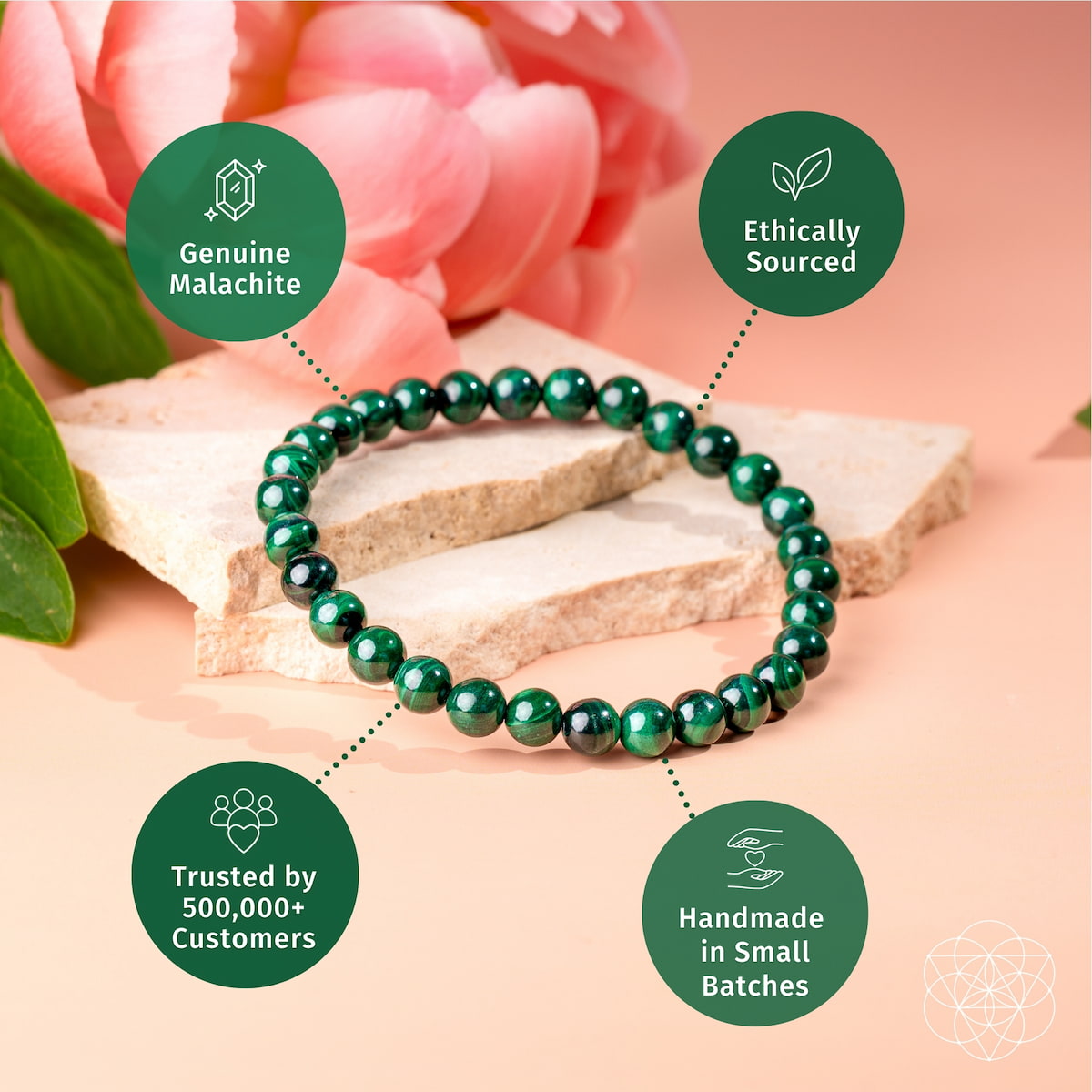
The Calm Bracelet | 6mm

What you're actually buying
You're buying a piece of stone, cut and polished, usually on a cord or a chain. It is a beautiful object. Carrying a small object deliberately — something you touch when your attention wanders, something that reminds you of an intention you set — is a very old human habit and it does something real for a lot of people. That something is attention and ritual, not mineralogy.
What it isn't is medicine. Rhodonite has been associated with forgiveness for a long time; obsidian with holding your ground; amethyst with clarity. Those associations are cultural and they're worth knowing, the same way the language of flowers is worth knowing. None of them is a mechanism, and no stone treats a condition.
We say this on a page where we are trying to sell you a bracelet, which is an odd commercial decision, but the alternative is joining the long line of shops happy to imply that a $19 bracelet will fix something that needs a doctor. We'd rather sell you a nice piece of obsidian honestly.
Against a mystery bag of 'healing crystals'
Buying stone online goes wrong in predictable ways: you don't know what mineral arrived, what size it is, or whether it was dyed on the way.
| Zaremora | The mystery bag | |
|---|---|---|
The specific stone is named |
||
Bead or piece size stated |
||
Natural variation explained before you buy |
||
Traditional association described, not promised |
||
No therapeutic or medical claims |
||
Care instructions, including what water will do to it |
Why these sit alongside bamboo sheets
Zaremora has always been about knowing what an object is made of. Usually that means naming a fibre or a foam. Here it means naming a mineral, saying how big it is, and admitting that natural stone is irregular by nature.
The crystal market runs on vagueness — unnamed stones, undisclosed dye, and claims that get bolder the less anyone can check them. A shop that tells you the stone, the size, the care and nothing more is a strange thing to find in this category. It shouldn't be.
Questions
Is this real stone?
Yes, and each product page names which one. Natural stone is the point and also the catch: colour, banding and translucency vary between pieces cut from the same material. Some stones on the market are routinely dyed or heat-treated — where that applies to a piece, it belongs on the page, and if a listing doesn't mention it anywhere, treat that as information too.
Will mine look exactly like the photograph?
No, and nothing natural will. The photograph is one piece. Yours will share the stone and the size and differ in the detail — a different pattern of banding, a slightly different depth of colour, an inclusion where the photo has none. That's what distinguishes stone from moulded resin.
How do I know what size bracelet to order?
Wrap a tape measure around your wrist where you'd wear it, snug but not tight, and add about half an inch for a comfortable fit on a stretch cord. The bead diameter is on the page — 6mm beads sit low and layer well with other bracelets; larger beads sit higher and read as a single statement piece.
Can I wear it in the shower or the sea?
Better not to. Water gets into the holes drilled through beads and works on the elastic from the inside, which is how stretch bracelets fail. Salt water and chlorine are harder still on both the cord and the polish on softer stones. Take it off for swimming and showering and it'll last years instead of months.
How do I clean it?
A soft dry cloth for most pieces, or a barely damp one followed by immediate drying. No ultrasonic cleaners, no jewellery dips, no household cleaning products — softer and more porous stones absorb liquid and dull permanently.
What does 'cleansing' or 'charging' a crystal mean?
It's a ritual practice, and it's usually described as clearing a stone of accumulated energy before setting a new intention with it. Different traditions use moonlight, running water, salt, smoke or sound. Nothing measurable happens to the mineral. If the practice is meaningful to you, it's yours to do — and avoid the water and salt methods on porous stones regardless, because those genuinely do cause damage.
Can I wear more than one?
Yes, and most people do. Smaller beads stack comfortably without catching on sleeves. Some people combine stones for their traditional associations, some just like how they look together, and either is a perfectly good reason.
Do crystals actually work?
Not in the sense of acting on your body — there's no mechanism for that and controlled studies don't find one. What they do reliably is give your attention somewhere to go. A deliberate object you touch when you're spiralling, tied to an intention you chose, is a real practice with a real effect on your focus. That's worth $19. A cure for anything is not what you're buying, and please don't use one in place of seeing a doctor about something that's worrying you.